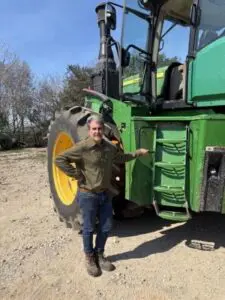
Louisiana sugarcane grower Chad Hanks recently traveled to Washington, D.C., to share firsthand with lawmakers the challenges farmers face today, from labor shortages to rising production costs. In this guest column, he explains why policies that support American agriculture are essential to keeping family farms viable for future generations.
Editor’s note: This column originally appeared in The Advocate.
Sugarcane is an inextricable part of the culture and economy in South Louisiana. Our state is the northernmost location in the world where sugarcane is grown, planted across more than 25 parishes and supporting nearly 20,000 jobs and more than $4 billion in annual economic impact.
As a sugarcane grower, my family depends on the sustainability of the sugarcane industry, but today we face serious challenges from labor shortages and stubborn inflation. That’s why I spent a week in February in Washington, D.C., pressing for policies that will keep farms like mine alive.
For example, sugarcane is a tropical grass. You can’t neatly drop seeds into furrows, you must plant parts of the grassy stalk, called billets, to grow. While most planting operations are mechanized, many farms still rely on workers to ensure those billets are correctly planted.
Throughout the season, there are many reasons to require farm labor and, similarly, harvest season requires boots on the ground. On my farm alone, we have 3,500 acres of sugarcane that must be cut every fall, either for planting new seed cane or to feed the sugarcane mill. It’s a lot of work to keep harvesters and carts running smoothly while delivering cane on a timely schedule to ensure the mill can run efficiently. Even with farm wages amounting to more than double the minimum wage, it has become increasingly difficult to secure the help we need to plant and harvest our sugarcane. Simply put, most Americans don’t apply to work on a farm during a hot and humid Louisiana summer.
While we always prefer to hire American workers, our farm does rely on migrant workers who legally come to work in the U.S. through the H-2A visa program. Many return year after year, determined to work hard and create a better life for their families back home. These workers are taking time away from their families to help plant, tend and harvest the crops that feed American families. It is a responsibility none of us takes lightly. Unfortunately, the programs that we rely on for these workers have become increasingly complex. Congress must act to make these programs truly workable for American agriculture.
Labor is one pressure. Inflation is another. The costs for farm inputs, such as new machinery, repairs, fuel and fertilizer have increased significantly in recent years. The U.S. Department of Agriculture forecasts that other expenses will continue to rise over the coming year, as well. Meanwhile, only about 24% of each dollar spent at the grocery store goes to farms, and less than that for the food you purchase in a restaurant. Farmers receive only a fraction of the food dollar spent by consumers.
I’m a first-generation sugarcane grower, having switched from rice 35 years ago. Even as our industry has adopted new technologies and modernized operations, the nature of sugarcane planting, cultivating and harvesting still requires significant human labor.We in the Pelican State are blessed to have a congressional delegation that recognizes the strategic importance of the Louisiana sugar cane industry, and I was proud to share our message with other federal lawmakers from across the U.S. to build support for American agriculture.
It is my hope that Congress will help ensure American farms will sustain many more generations to come.